Exercise 3-1 Investigate the information generated by the traditional screen model in a typical operating environment.
Start a new job in MODSIM and draw a flowsheet containing only a single-deck screen.
Add a feed stream and product streams for oversize and undersize. Add flyouts to each stream.
Accept the flowsheet and edit system data.
Use the following settings: 1 mineral sp. gr. 2.7, 25 size classes, maximum particle size 15 cms.
Specify the feed: 300 tonne/hr. at 95% solids with Rosin-Rammler distribution having D63.2 = 4 cm and = 1.2 Use 20 mesh sizes in the feed size distribution data.
Don't forget to name the two product streams for convenient reference later.
Edit unit parameters. Use model SCRN for the vibrating screen. Check the help box the first time you select the model to see a brief description of the model. Choose the following parameters: mesh size 3 cm, transmission efficiency 90%, surface water on oversize 2%. Do not specify screen dimensions on the first run.
Accept the parameters and run the simulation. View the flowsheet. Check the data in the stream flyouts which show the total tonnages in each stream.
Right click on the screen icon to see the report file for that unit. Examine the report file carefully to become familiar with the information that it provides. Note in particular that the basic capacity factor for this screen is 60.5 tonnes/hr. Note the calculated values of the six correction factors and that 5.76 sq.meters of screen area would be required for this duty.
View the size distribution graphs (View menu).
Size distribution graphs and the report file for the screen are shown below for reference.
Modify some of the unit parameters and note how the performance data changes after each simulation run.
Save the job as Exercise 3-1.
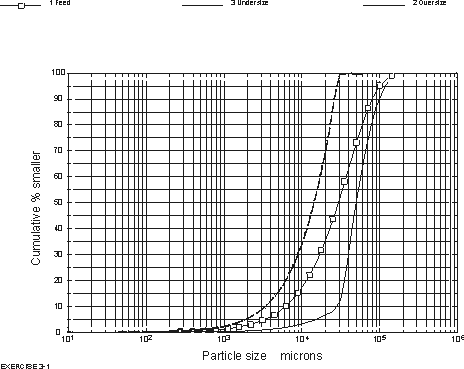
Size distributions of the feed oversize and undersize using the traditional model.
Unit number
1 MODSIM model name SCRN
Job name: Exercise 3-1
There is/are 1 screen/s inparallel
Tonnage
to be processed 300.0 tonnes/hr.
Tonnage in undersize product 137.3 tonnes/hr.
Mesh
size 30.00 mms.
Surface water on deck oversize 2.0 %
Factors are calculated for horizontal screen.
Basic capacity = 60.490 tons per hour per square meter
Particle
size distribution in the feed.
Size % passing
mms
126. 98.11
89.2 92.70
63.1 82.22
44.6 68.00
31.5 52.85
22.3 39.09
15.8 27.91
11.2 19.42
7.88 13.28
5.58 8.97
3.94 6.01
2.79 4.01
1.97 2.66
1.39 1.76
.986 1.17
.696 .77
.493 .51
.348 .34
.247 .23
.174 .16
.123 .11
.871E-01 .08
.616E-01 .06
.435E-01 .04
.000 .00
Percent
oversize in feed 49.26%
Oversize factor is 1.164
Percent half size in feed 26.53%
Half-size factor is .731
Deck location factor 1.00
Specific gravity of material in feed 2.70
Bulk density of material in feed 1620. kgs/m**3
Bulk density factor is 1.013
Screen area required 5.762 sq meters
Particle
size distribution in the overflow.
Size % passing
mms
126. 96.51
89.2 86.54
63.1 67.22
44.6 40.99
31.5 13.04
22.3 7.21
15.8 5.15
11.2 3.58
7.88 2.45
5.58 1.65
3.94 1.11
2.79 .74
1.97 .49
1.39 .33
.986 .22
.696 .14
.493 .09
.348 .06
.247 .04
.174 .03
.123 .02
.871E-01 .01
.616E-01 .01
.435E-01 .01
.000 .00
Particle
size distribution in the underflow
Size % passing
mms
126. 100.00
89.2 100.00
63.1 100.00
44.6 100.00
31.5 100.00
22.3 76.86
15.8 54.87
11.2 38.18
7.88 26.10
5.58 17.63
3.94 11.82
2.79 7.88
1.97 5.24
1.39 3.47
.986 2.29
.696 1.52
.493 1.00
.348 .66
.247 .45
.174 .32
.123 .23
.871E-01 .16
.616E-01 .11
.435E-01 .08
.000 .00
NOTES: